
Leonardo da Vinci’s The Last Supper and two recontextualizations

Irina Moreno – MA in contemporary art, Sotheby’s Institute of Art, London and PhD candidate, De Montfort University, Leicester
Arguably one of the great masterpieces of the Italian Renaissance, The Last Supper (in Italian Il Cenacolo or La Ultima Cena) was painted by Leonardo da Vinci between 1495 and 1498 in the refectory of Santa Maria delle Grazie in Milan. The painting was commissioned by Da Vinci’s patron Ludovico Sforza, Duke of Milan.
The work depicts Jesus’ last meal with his apostles before his crucifixion. Specifically, the painting captures the moment when Jesus announces Judas’ betrayal.
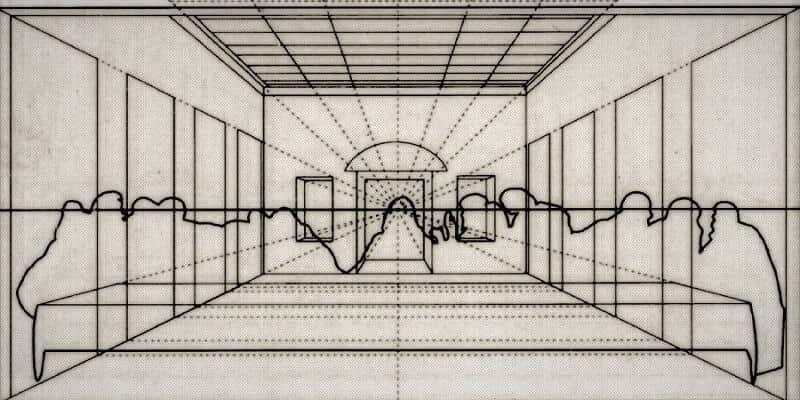
The Last Supper is one of the greatest examples of one-point perspective. Every single element of The Last Supper points to Jesus’ right temple. This type of linear perspective creates the illusion of depth. Da Vinci marked the vanishing point by driving a nail into the wall. From there, he strung thread to create diagonal lines. These lines radiate and meet the corners of the windows, the lines in the ceiling, the corners of the table, and the panels on the side walls.
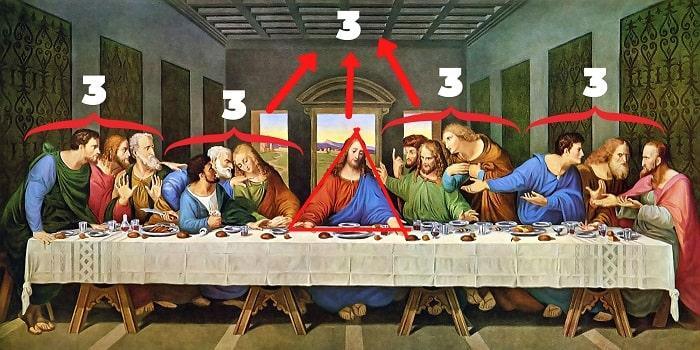
The symmetrical balance is further emphasized by the placement of the characters. The twelve apostles are divided into four groups of three and placed equally on both sides of Jesus. The work includes several references to the number 3 (which symbolizes the Holy Trinity). Besides dividing the apostles into groups of three, the painting contains three windows. Also, the shape of Jesus is triangular. However, Da Vinci secularized the scene, removing the halo from Jesus and the apostles. He used the faces of real people to render the faces of the apostles.Reportedly, he visited Milanese jails in search of a criminal with an appropriate face and expression for Judas.
To add a dose of drama, Da Vinci used a technique called chiaroscuro. The term chiaroscuro stems from the Italian words chiaro (“clear” or “bright”) and oscuro (“obscure” or “dark”) and refers to the strong contrast between light and dark. In addition to illuminating a subject, chiaroscuro creates a sense of depth, volume, and drama. In The Last Supper, the light coming through the windows behind Jesus illuminates the characters, highlighting their features and gestures and contributing to the scene’s intensity.
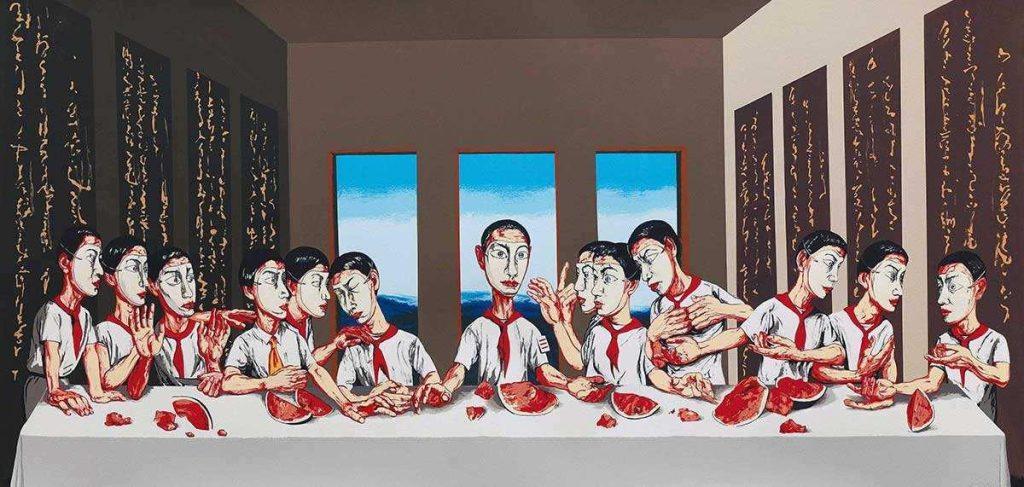
While the apostles are visibly troubled by the news, Jesus seems calm and collected, providing an emotional anchor. The objects around Jesus are in disarray, symbolizing the chaos that will follow in his absence. With his arms spread out, he points to the bread and wine in front of him, alluding to the last judgment. The hand of refusal represents condemnation, while the giving hand, pointing to the bread, heralds the heavenly banquet.The Last Supper has been a source of inspiration for many artists. One of them is Chinese painter Zeng Fanzhi (b. 1960). In 2001, he created a work entitled The Last Supper. In his Last Supper, Zeng Fanzhi replaced the religious figures from Da Vinci’s The Last Supper with young pioneers wearing white masks and red scarves. Instead of the traditional religious setting, the reunion now takes place in a classroom and the meal consists of watermelon slices. The piece is imbued with metaphors hinting at the changes that took place in China after the Cultural Revolution came to an end.
The red scarves represent communist ideals and “collectivism,” while Judas’ golden tie symbolizes money and western capitalism. Jesus is none other than the leader of China. When faced with the possible betrayal of his people, he predicts: “One of us here will follow the path of capitalism.” The traitor is the person donning the golden tie. Ultimately, Fanzhi’s Last Supper paints the picture of the Chinese society as it moved away from collective ideals and turned towards individual entrepreneurship.
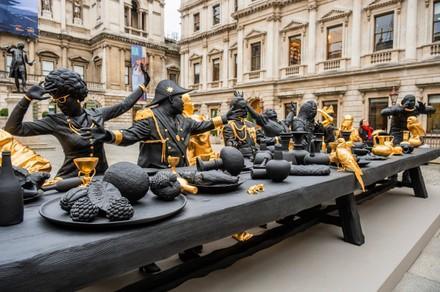
The First Supper (Galaxy Black) by Bahamian artist Tavares Strachan (b. 1979) is now on view in the public courtyard at the Royal Academy of Arts in London. Dated 2023, the sculpture took four years to complete. The First Supper (Galaxy Black) is part of the exhibition “Entangled Parts, 1768-Now: Art, Colonialism and Change” (February 3 – April 28, 2024).
Inspired by Leonardo da Vinci’s The Last Supper, Strachan’s First Supper shows a friendly reunion of key historical figures from Africa and its Diaspora. They include abolitionist Harriet Tubman, activist Marcus Garvey and gay rights campaigner Marsha P. Johnson, nurse Mary Seacole, gospel singer Sister Rosetta Tharpe, U.S.’s first Black congresswoman Shirley Chisholm, poet Sir Derek Walcott, Brazilian resistance fighter Zumbi Dos Palmares, Jamaican sound engineer King Tubby, astronaut Robert Henry Lawrence, and explorer Matthew Henson. Strachan casted former Ethiopian emperor Haile Selassie as Jesus and himself as Judah.
According to art historian Alayo Akinkugbe, “positioning himself as traitor represents the artist’s betrayal of history’s status quo by bringing to light these marginalized figures in a composition that is typically associated with Christ and his disciples.”
The work was crafted from bronze, black patina, and gold leaf. The gold leaf symbolizes Europeans’ attraction to West Africa’s “Gold Coast” in the 15th Century. The table is filled with rice, fish, chicken, cocoa, custard apple, and other foods traditionally consumed in the Caribbean. These foods have indigenous and African influences and are reminiscent of slavery. The nod to colonialism notwithstanding, the work suggests a return to the simple act of eating together. From small dinners to large gatherings, communal eating increases social bonding and fosters a sense of belonging and connectedness.


Responses