
Cluj School of Painting: Reasons for Adrian Ghenie’s Rise to Prominence on the International Market


Largely unknown to western collectors, dealers, and curators until twenty years ago, Romanian artists have won accolades internationally for presenting works that are both technically exquisite and intellectually engaging.
One member of the now-famous Cluj School, Adrian Ghenie, is redefining painting by creating works that aim to close history’s darkest chapters while serving, at the same time, as identity search instruments. Demand for Ghenie’s paintings rose dramatically since he first burst onto the art scene in the mid-2000s. This article attempts to present the reasons for the artist’s meteoric rise to prominence and the sudden increase in value of his works.
To better understand the context in which contemporary art was created in Romania, one needs to consider the sociopolitical setting of the past thirty-five years. The end of 1989 marked the end of communism in Eastern Europe. For decades, communism stripped Romanians of basic freedoms and rights. Creative expression was strictly prohibited.
Artists were forced to follow precise party lines and use their work to glorify the regime and its leaders. While workers were stimulated to exceed their quota of goods production, artists were viewed as key creators of propaganda. The more their works managed to convey a strong political, ideological, and moral message, the higher their chances of recognition by the communist party.
This recognition, in turn, led to a relatively privileged life with access to party members-only events and advantages over the rest of the population. While for most people daily existence meant fighting for the lowest possible level of physical nourishment, those who sympathized with the communist regime received a milder treatment and were able to live relatively well. It was easy to fall into this trap and many did.
Artists had no choice but to comply with the communist dogma. Moreover, since they had no exposure to art from non-communist countries and the curriculum taught in art school did not include post-war art, artists focused solely on technique. The lack of cultural exchange with peers from western countries deeply affected Romanian artists’ awareness of international developments and contributed to their involuntary brainwashing.
In 1989, Romania was 45 years behind in artistic and sociocultural evolution. Consequently, although the fall of the Ceausescu regime turned despotism into democracy, changes did not occur overnight. Carrying the burden of the long-lasting psychological wounds inflicted by totalitarianism, the transition period was long and difficult.
Following Ceausescu’s assassination, Romania started writing a new chapter in its history. While some attempted to move away from the suffering caused by the oppressive regime by erasing past traumas, most people felt that old sores needed to be unveiled to bring morality to a deeply corrupt society.
The reinstatement of freedom of speech and of self-expression allowed artists to shift from mainly communist-inspired propaganda themes to renderings of the human condition under political oppression. Albeit in a fictionalized, artistic manner, incidents that took place in the past and had been covered up for decades were finally being revealed. The victimization under communism was to be exposed placing unsung heroes at the heart of the Romanian art discourse.
After a failed attempt to settle in Vienna, Adrian Ghenie returned to Cluj and, in 2005, partnered with Mihai Pop, a Cluj-based curator and multimedia artist, to open Plan B, a gallery dedicated to exhibiting and promoting works by local contemporary artists.
Despite the lack of public funding and a viable collector base, Ghenie and Pop pursued their dream and created what in less than five years was to become the most active Romanian commercial gallery on the international art scene. Their success, however, did not come overnight or by chance. They had a vision and a plan. Reflecting on their previous failures, the two called the new gallery Plan B.
The gallery’s success, as well as Adrian Ghenie’s rise to fame, could be traced back to the meeting between Ghenie, fellow Cluj artist Victor Man, and British curator and leading expert on Eastern European contemporary art, Jane Neal, at the 2005 Prague Biennale. Upon attending Plan B’s inaugural exhibition, Neal advised Juerg Judin of Haunch of Venison in Zürich to look at the new art being created in Cluj.
When Juerg Judin visited Plan B Gallery in 2006, Ghenie’s portfolio consisted of only seven small-size, monochromatic paintings, all depicting burial sites. That same year, gallerist Mihai Nicodim presented Adrian Ghenie’s gripping canvases at the Zoo Art Fair in London.
Value-priced at $2,000 each, Ghenie’s works attracted the attention of Susan and Michael Hort, avid collectors of emerging contemporary art known for spotting up-and-coming talent. They bought most of Mihai Nicodim’s booth. A month later, in November 2006, when Haunch of Venison in Zürich introduced seven artists from Cluj, Ghenie’s works sold out.
Following Ghenie’s success, Judin added him to the gallery’s roster of artists and offered him the chance to showcase his works in a solo exhibition. Shadow of a Daydream, Ghenie’s first international solo show, opened in November 2007 at Haunch of Venison. It presented new paintings inspired by the artist’s residency in Berlin. While preserving Ghenie’s dark style and uncanny narrative, these new works were significantly larger in size and signaled a shift toward mixing personal stories with collective memories.
The artist’s second solo show at Haunch of Venison, Darkness for an Hour, in May 2009, was a sell-out. François Pinault, founder of the luxury group Kering, which owns fashion brands Saint Laurent, Alexander McQueen, and Gucci, bought Nickelodeon (2008), the exhibition’s centerpiece.
Nickelodeon (2008), oil, acrylic and tape on canvas (in two parts), 238 x 414 cm (overall). Source: Plan B Gallery
The show’s success prompted the gallery to invite Ghenie to exhibit again with them in London in 2011. Priced between €35,000 and €100,000, all works were gone before the show’s September 2011 opening.
Ghenie’s works are fictionalized lessons in history and art history in which time stops and warps simultaneously. Personal memories are intermingled with gloomy history scenes yielding ghostly depictions of stories that exist only in the artist’s imagination. Ghenie’s skillful staging of the compositions leads to a sense of alienation and despair. His paintings depict images of somber, hermetic interiors where death or the premonition of death is present.
Although seemingly realistic, his works pervade surrealism. Dim lighting helps his characters avoid the viewers’ gaze. Distortion is at play in Ghenie’s work with some characters completely lacking facial features. Through the use of impasto and scraping beyond recognition, the artist mutilates images of historical figures destroying iconic portraits.
Faces of humanized villains are blurred and covered in thick layers of paint as if hiding beneath their own sinful past. This deliberate act of painterly degradation leads to characterizations rather than portraits. Pain, suffering, remorse are omnipresent giving the characters a historical archetype feel devoid of the cult of personality elements or individualism. Pie Fight Study 2 (2008) is a case in point.
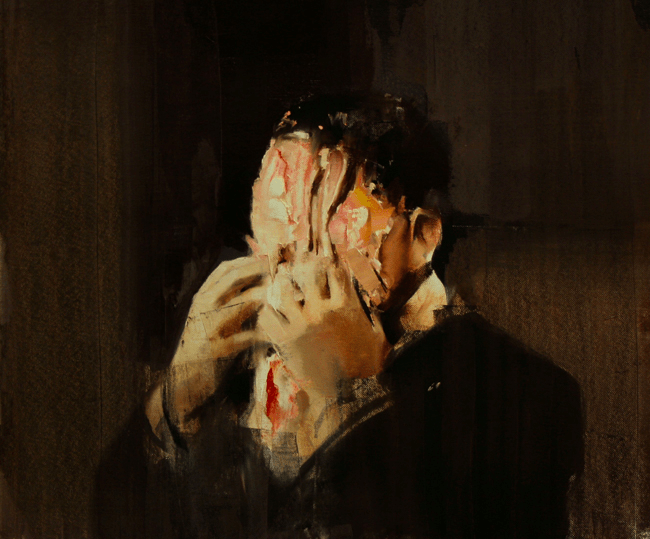
Pie Fight Study 2 (2008), oil on canvas, 55 x 59 cm. Source: Gallery Judin
Moreover, appropriation plays an important role in Ghenie’s paintings. The artist relies on published photographs to reconstruct events that occurred in the past. His renderings, however, are fictionalized as the rooms and events he is recreating often include elements from his own surroundings or objects that he is bestowing upon his characters based on information culled from their biographies.
In That Moment (2007), Ghenie choses to place the Discobolus of Myron in the room where a man and a woman lie lifeless in what appears to be the aftermath of their double suicide. The selection of the sculpture hints to the identity of the couple and the moment the title is referring too.
Based on a photograph of Hitler posing next to the Discobolus Palombara in the Munich Glyptothek, the viewer is led to believe that two bodies are those of Adolph Hitler and Eva Braun. Although not based on factual information, Ghenie’s deliberate placement of the Discobolus in the painting’s narrative allows us to visualize an event that lacks a clear image despite being deeply rooted in our memory.
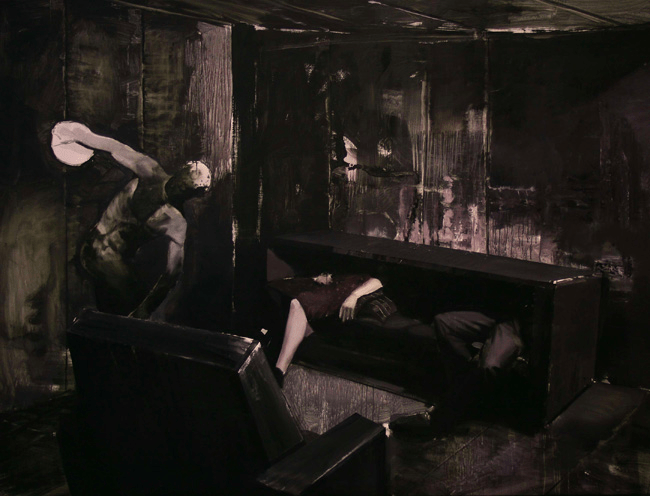
That Moment (2007), oil on canvas, 175 x 230 cm. Source: Wildenstein Gallery
Death is a recurring theme in Adrian Ghenie’s work. In Duchamp’s Funeral I (2009), the artist presents the viewer with the image of a dead Duchamp, as implied by the title, lying in his coffin. The decor includes items belonging to Ghenie, among them his studio chair as well as his grandmother’s red Turkish rug, which the artist places over the casket adding color to an otherwise somber setting. Ghenie uses the medium of painting to bring Duchamp into his space where he buries the great Dada master along with his death of painting beliefs.
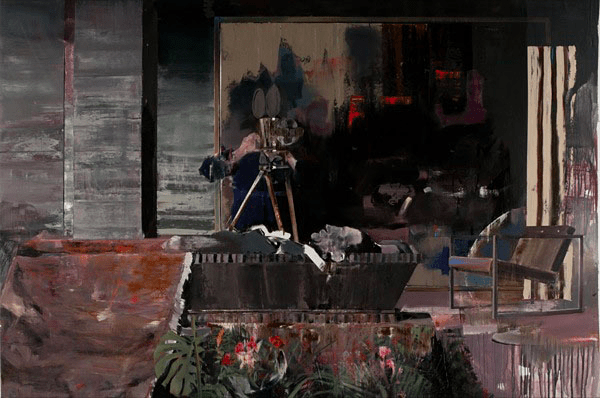
Duchamp’s Funeral I (2009), oil on canvas, 200 x 300 cm. Source: Christen Sveaas Art Foundation
Ghenie is digging the past to uncover forgotten truths. His work, albeit visual, is reminiscent of Walter Benjamin’s reflection on the nature of memory. In his autobiographical essay Berlin Chronicle, Benjamin associates the act of remembering with archeological excavation.
Infused with a high dose of drama, Ghenie’s works created after 2006 signal both an increase in the narrative’s intensity and a departure from old canons. Artistic development notwithstanding, the change in Ghenie’s work was largely triggered by the exposure to western views and practices.
Once Ghenie and his contemporaries were able to travel abroad and see what other artists were creating and how they promoted their works, Romanian artists refined their style and channeled their marketing efforts toward the western market.
Indeed, Romanian artists applied what they learned in their trips abroad, albeit with a twist. They did not fall into the trap of following trends, nor did they create works that matched the expectations of the western art world. Seeing what everyone else was doing, they realized the only way to stand out was to produce works that showed their engagement with issues they personally related to.
The new wave of artists from Cluj was collectively known as the artists belonging to the Cluj School, a term coined by Giancarlo Politi, founder of Flash Art Magazine. What they had in common, aside from receiving the same training at the University of Art and Design Cluj, was the shared experience of growing up under communism and watching the regime’s demise followed by the fast arrival of the new consumer culture.
Witnessing the transition from the communist propaganda to the advertisement indoctrination allowed artists to create works that were gloomy yet imbued with meaning and sarcasm.
Artists belonging to the Cluj School created art was fresh and powerful. It exuded passion and vision. It stemmed from personal experiences, yet it unveiled universal truths. Their bold and genuine style took experts, dealers, and collectors by surprise. Romanian artists defied western stereotypes of poverty and vampires by creating works that dealt with feelings and emotions. The art world took notice and started looking closely at the new art coming from Romania.
Undeniably, the country’s 2007 entry into the European Union helped facilitate communication. Prices followed the growth in interest and soon works started trading at higher-than-expected levels. Rather than losing its appeal as time went by, Romanian art gained more recognition with collectors and museums alike vying for the best examples of works coming from the new darlings of contemporary art.
In 2011, Ghenie participated in the group show The World Belongs to You held at François Pinault Foundation, Palazzo Grassi in Venice, Italy. Noticing Ghenie’s works in Pinault’s Collection, Polly Robinson Gaer, Senior Director at Pace London, invited the artist to join Pace Gallery.
In October 2012, works by Adrian Ghenie were included in the Francis Bacon and the Existential Condition in Contemporary Art show at Palazzo Strozzi in Venice, Italy. The decision to include Ghenie’s works in the show was taken by the exhibition’s co-curators, Franziska Nori, director of the Center for Contemporary Culture Strozzina, and Barbara Dawson, director of the Dublin City Gallery The Hugh Lane, and was based on Ghenie and Bacon’s similar depiction of the human figure and their shared interpretation of man’s existential suffering.
By placing Ghenie’s paintings in dialogue with those of Francis Bacon, Ghenie’s status was catapulted from a rising international star to a force to be reckoned with, bringing along an even higher interest in his works and triggering a sharp increase in prices. Works by Ghenie that came on the block immediately following the show at Palazzo Strozzi vaulted over their presale estimates positioning the artist firmly in the realm of most desirable artists. In February 2013, a small, Baconesque portrait of Josef Mengele, Dr. Mengele 2 (2011), realized £121,250, three times its high presale estimate of £40,000, at Sotheby’s Contemporary Art Evening sale in London.
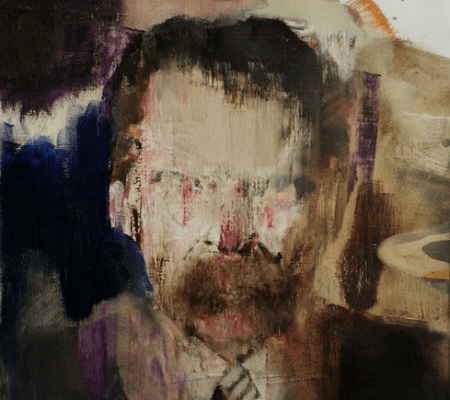
Dr. Mengele 2 (2011), oil on canvas, 49 x 43 cm. Source: Artnet
In March 2013, Ghenie’s show New Paintings opened at Pace New York. All thirteen works sold before the opening. Prices ranged between $65,000 and $350,000. The artist’s evening sale debut in February 2013 along with his continued success on the primary market, paved the way for sales of his works to soon surpass the million £ mark.
By 2014, Ghenie’s paintings were highly sought after at Sotheby’s evening sales. His Duchamp’s Funeral I (2009) was placed across the top lot in the viewing room at Sotheby’s Contemporary Art Evening auction in London and subsequently sold for £1,022,000 in October 2014, while The Fake Rothko (2010) sold for £1,426,400 in June 2014.
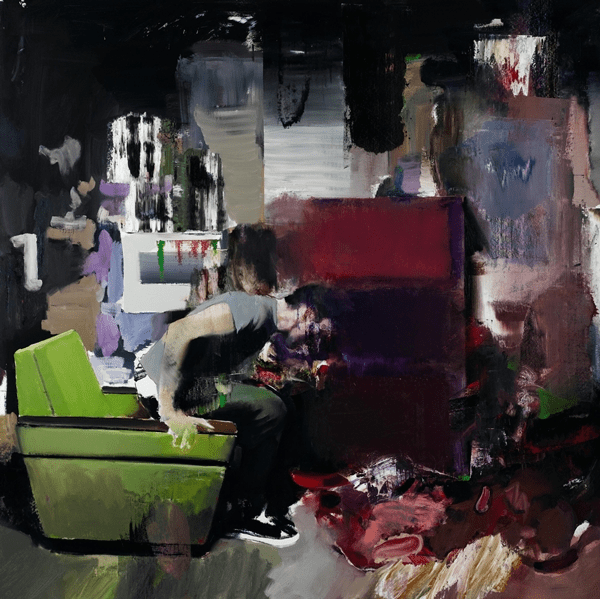
The Fake Rothko (2010), oil on canvas, 200 x 200.6 cm. Source: Artnet
What draws dealers and collectors to Ghenie’s work is the timelessness of his paintings, the confidence they exude. His meteoric rise on the international art scene stems from the appeal of his work: dark, macabre, poignant.
Museums took note and started buying select works to include in their collections. Today, Adrian Ghenie’s works are to be found in Hammer Museum, Los Angeles, Museum of Contemporary Art, Los Angeles, Museum van Hedendaagse Kunst, Antwerp, SFMOMA, San Francisco, Centre Pompidou, Paris, and S.M.A.K, Ghent.
As interest in his paintings rose, prices continued to increase in response to higher demand. Being represented by Pace Gallery and Thaddaeus Ropac Gallery has helped Adrian Ghenie reach new heights in terms of validation and valuation.
The inclusion of his works in the 2012 Francis Bacon and the Existential Condition in Contemporary Art show at Palazzo Strozzi in Venice, Italy, was a key milestone in the artist’s career. Moreover, low output drives up the competition and prices for the work. Ghenie is known for working slowly. The artist produces only about a dozen works per year.
In October 2016, François Pinault sold Nickelodeon (2008). The work fetched £7,109,000 at Christie’s in London. Five years later, in May 2022, Pie Fight Interior 12 (2014) sold for $10.3 million at Christie’s Hong Kong, setting a new record for the artist at auction.
Spanning three-and-half meters wide and almost three meters high, Pie Fight Interior 12 (2014) is amongst the largest canvases in Ghenie’s entire body of work. The painting depicts a brightly clad woman standing in front of a devastated area and removing paint – or a pie – from her face. The aftermath of destruction conveys a feeling of frustration and vulnerability. Pie Fight Interior 12 (2014) is, ultimately, a commentary on the transience of life.
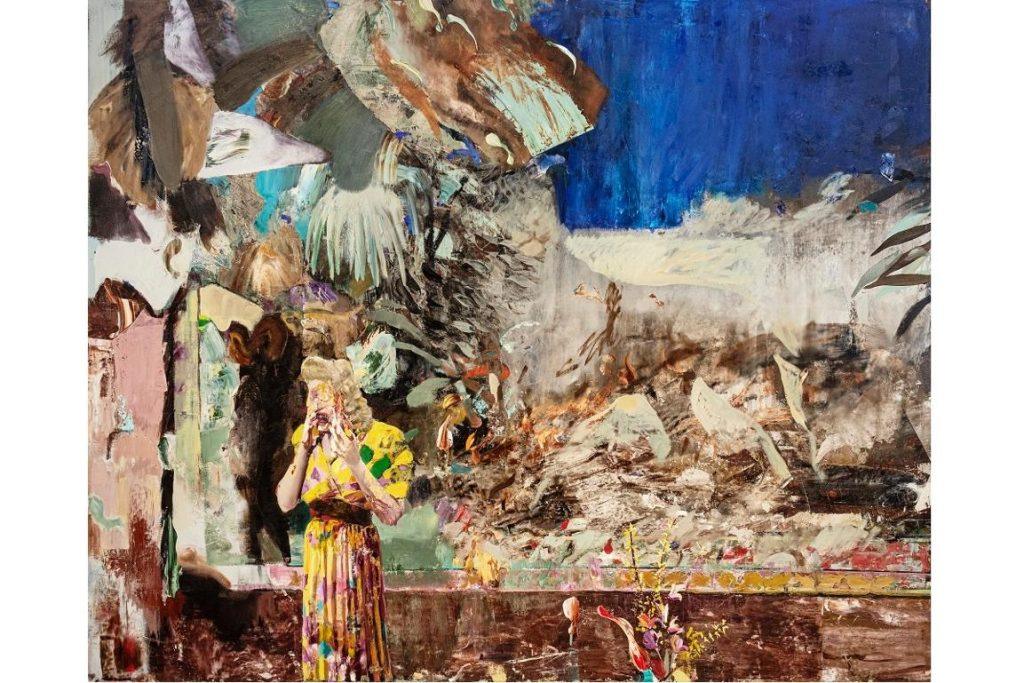
Pie Fight Interior 12 (2014), oil on canvas, 284 x 350 cm. Source: Thaddaeus Ropac Gallery
In 2015, Adrian Ghenie represented Romania at the 56th Venice Biennale.
This year, the Romanian Pavilion at the Venice Biennale showcases the works of Șerban Savu, another Cluj School artist. The 60th Venice Biennale, world’s preeminent art event, started on April 20 and will continue until November 24, 2024.




Interesting post!
😍😍😍