
Redefining Power and Identity: The Art of Kehinde Wiley

Kehinde Wiley (b. 1977) is a contemporary American artist renowned for his vibrant and larger-than-life portraits that reimagine the traditional form of classical portraiture. His work is distinguished by its bold fusion of historical references with modern-day subjects, often featuring African American men and women in poses reminiscent of Old Master paintings.
Wiley’s art challenges conventional notions of power and representation by placing individuals who are typically marginalized in society into the grand narratives of art history. Through his striking use of color, intricate patterns, and detailed realism, Wiley’s portraits not only celebrate the beauty and dignity of his subjects but also provoke deeper reflections on race, identity, and cultural legacy.
Kehinde Wiley uses street casting as a key method to recruit his models. Rather than relying on professional models, Wiley conducts casting sessions in urban environments. He engages with individuals he encounters on the streets, inviting them to pose for portraits in his studio. The models get to choose a pose from a classical painting and reenact it. This collaborative approach not only empowers the models by giving them agency in the artistic process but also connects them to the rich history of portraiture that Wiley seeks to challenge and reinterpret.
The artist’s first breakthrough came in 2001 shortly after completing his Master of Fine Arts at Yale University. He was commissioned by the Studio Museum in Harlem to create a series of portraits. This opportunity allowed him to explore his emerging style, blending classical European portraiture with contemporary African American subjects. Over time, Kehinde Wiley produced a significant body of work that consistently reimagines and reinterprets classical art through a contemporary lens. One of his most famous pieces is Napoleon Leading the Army Over the Alps (2005), in which Wiley recreates Jacques-Louis David’s 1801 painting of Napoleon Bonaparte. In Wiley’s version, the figure of Napoleon is replaced by a young African American man depicted wearing contemporary streetwear, riding a rearing horse, and surrounded by gold sperm cells. The floating sperm cells allude to masculine might, a concept typically associated with military aggression and dominance. The model’s last name, Williams, is inscribed alongside names of historical commanders. Wiley’s Napoleon Leading the Army Over the Alps maintains the grandiosity and dynamism of the original while challenging the traditional portrayal of power and heroism.
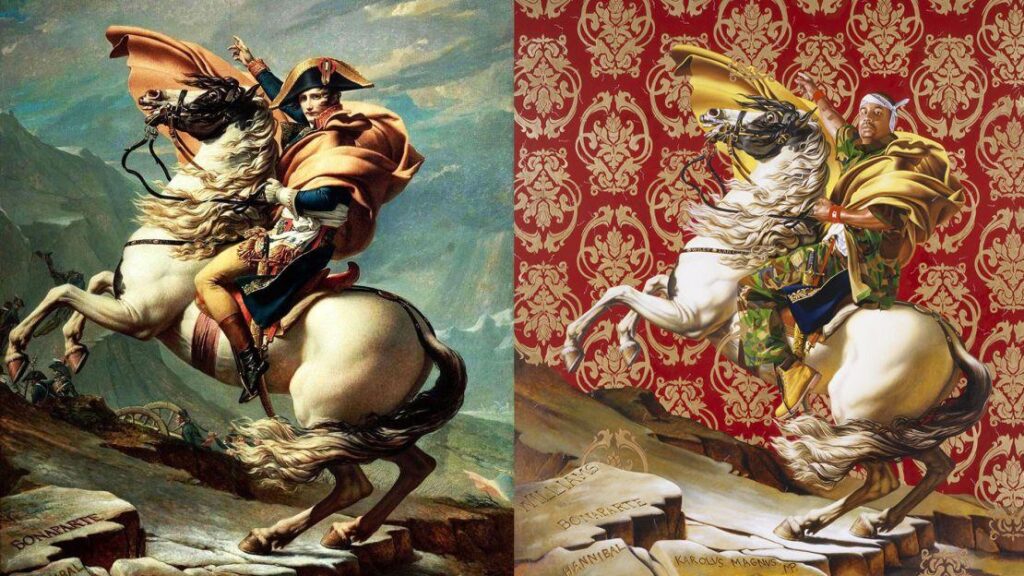
LEFT: Jacques-Louis David (French, 1748-1825), Napoleon Crossing the Alps or Bonaparte at the St Bernard Pass, 1801, Österreichische Galerie Belvedere. © Österreichische Galerie BelvedereRIGHT: Kehinde Wiley (American, 1977–), Napoleon Leading the Army over the Alps, 2005, Brooklyn Museum of Art, New York. © Brooklyn Museum of Art, New York
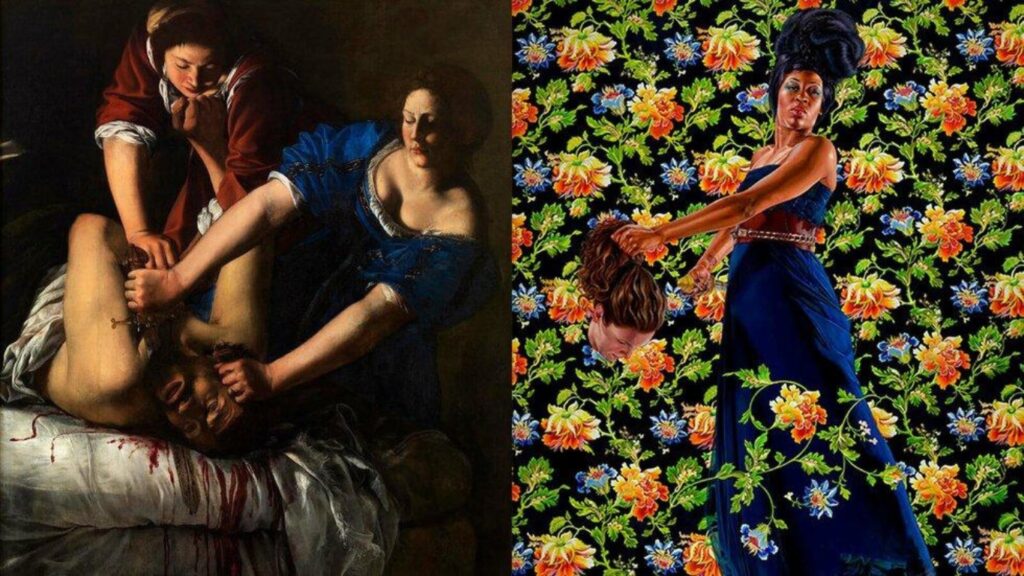
Wiley’s work Judith and Holofernes (2012) belongs to the artist’s first series of paintings to feature female subjects. The work is a striking reinterpretation of the famous Baroque painting by Artemisia Gentileschi. Wiley found the model for Judith at Fulton Mall in downtown Brooklyn. She is depicted wearing a dress by Italian designer Riccardo Tisci of Givenchy. The model for the head of Holofernes is one of the artist’s assistants.
The story of Judith and Holofernes is found in the biblical Book of Judith, which is part of the Apocrypha. It tells the tale of Judith, a courageous and beautiful widow from Bethulia, who saves her city from the siege of Holofernes, an Assyrian general. Judith plays a crucial role in killing Holofernes by using her beauty and cunning to infiltrate the enemy camp. Gaining his trust during a banquet, she waits until he becomes intoxicated before decisively beheading him with his own sword. Her actions save her city from destruction, establishing her as a powerful symbol of female agency and heroism in biblical history.
In this contemporary version, Wiley captures the dramatic scene of Judith beheading Holofernes. Unlike Gentileschi’s original, which portrays Judith as a determined yet vulnerable figure, Wiley’s interpretation features a modern African American woman taking on the role of Judith, embodying strength, and defiance. By placing an African American woman in this historically significant narrative, Wiley not only pays homage to Gentileschi’s work but also emphasizes the importance of representation and the reclamation of power narratives within art history.
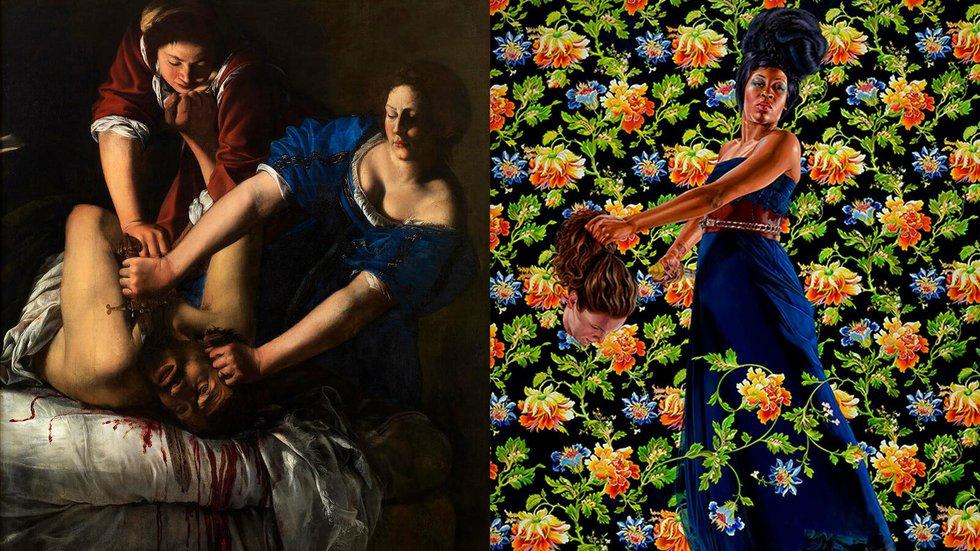
LEFT: Artemisia Gentileschi (Italian, 1593-1653), Judith and Holofernes, 1613, Museo Capodimonte, Naples. © Museo Capodimonte
RIGHT: Kehinde Wiley (American, 1977–), Judith and Holofernes, 2012, North Carolina Museum of Art. © North Carolina Museum of Art
Wiley’s Charles I (2018) is a reinterpretation of the iconic 17th-century portrait of King Charles I of England, originally created by the Dutch painter Daniel Mytens. In his rendition, Kehinde Wiley replaces the historical monarch with a contemporary African American woman, dressed in regal attire and posed with the same authoritative presence as the original king.
By positioning an African American woman in a role traditionally occupied by a white male monarch, Wiley challenges the historical narratives of power and representation, inviting viewers to reconsider the implications of race and identity in the context of royal imagery. The woman depicted in Wiley’s work is Ashely Cooper from Saint Louis, Missouri. In 2017, Wiley visited neighborhoods north of Saint Louis and selected individuals to pose for his paintings. Cooper was one of them.
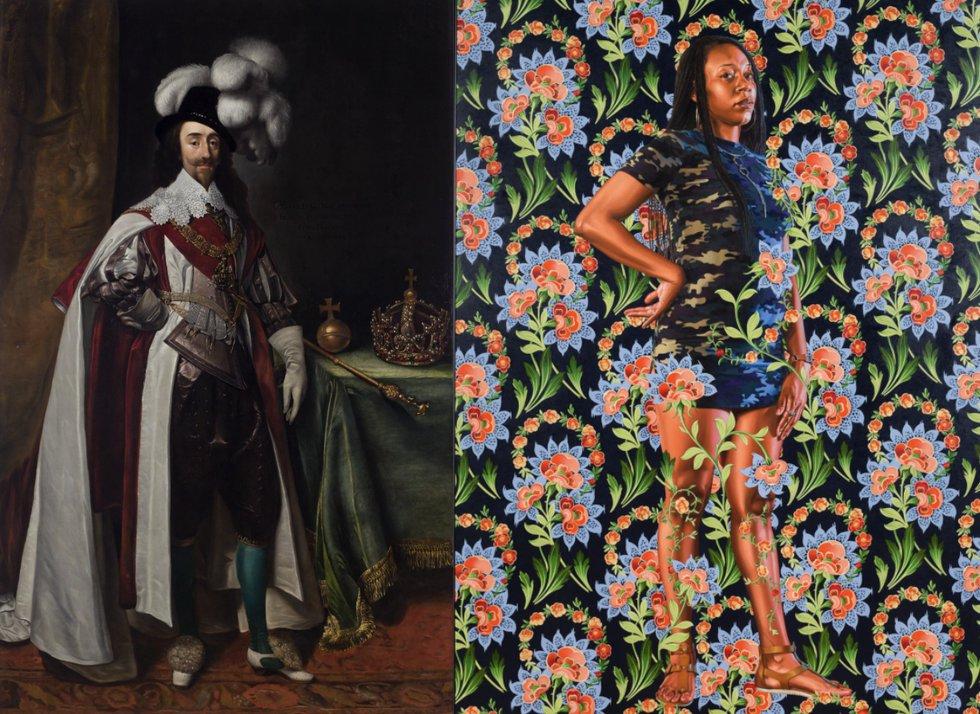
LEFT: Daniel Mytens (Dutch, 1590-1648), Charles I, 1633, Saint Louis Art Museum. © Saint Louis Art Museum
RIGHT: Kehinde Wiley (American, 1977–), Charles I, 2018, Saint Louis Art Museum. © Saint Louis Art Museum
Kehinde Wiley gained widespread recognition for his official portrait of President Barack Obama. Unveiled in 2018 at the Smithsonian National Portrait Gallery, the painting features Obama seated on a wooden chair, set against a vibrant background of lush foliage. The greenery includes symbolic flowers such as African blue lilies, jasmine, and chrysanthemums, representing different aspects of Obama’s heritage and life journey.
Kehinde Wiley’s portrait of President Obama plays a crucial role in shaping the legacy of the 44th president, offering a fresh perspective on presidential imagery. By blending realism with symbolic elements, Wiley’s work ensures that Obama’s legacy is viewed not only through a political lens but also as a reflection of his enduring impact on American society, inspiring future generations to reimagine leadership and identity.
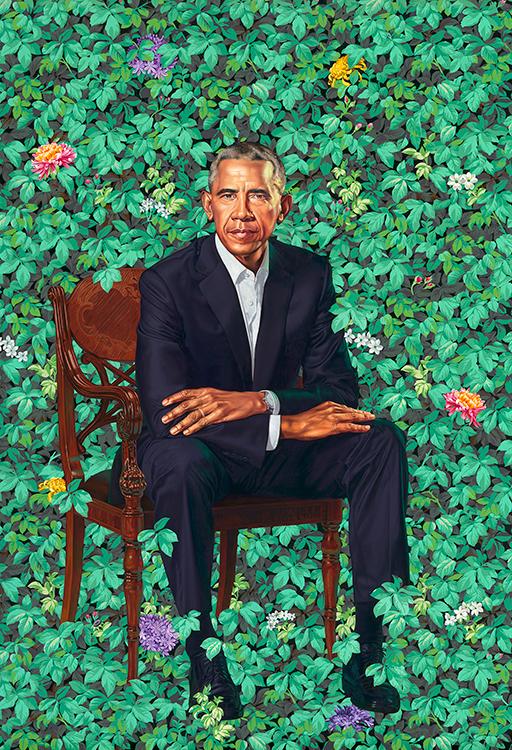
Kehinde Wiley (American, 1977–), Official Portrait of President Obama, 2018, National Portrait Gallery. © National Portrait Gallery
Kehinde Wiley has firmly established himself as a pivotal figure in American contemporary art, reshaping the landscape of portraiture with his innovative and thought-provoking works. By blending classical techniques with modern cultural references, he creates powerful visual narratives that challenge historical norms and elevate underrepresented voices. Wiley’s art not only redefines how we perceive race, identity, and power but also enriches the broader conversation about inclusion and representation in the art world. His contributions continue to resonate, ensuring his lasting impact on both the art community and society at large.


Responses