
Maurizio Cattelan: Redefining Art, One Provocation at a Time


Very few artists have mastered the art of provocation quite like Maurizio Cattelan, whose audacious works consistently challenge societal norms and cultural conventions. From Comedian, the infamous banana duct-taped to a wall, to America, a fully functional toilet crafted from 18-carat solid gold, Cattelan’s creations spark heated debates on history, society, and culture. Seamlessly blending satire and critique, his art invites audiences to grapple with uncomfortable truths, delivered with a sharp sense of humor and a deliberate irreverence.
Born in Padua, Italy, in 1960, Maurizio Cattelan grew up in a working-class family and had no formal artistic training, an unconventional beginning that has shaped his rebellious approach to art. Before entering the art world, he worked various odd jobs, including as a furniture maker, experiences that would later influence his DIY aesthetic and conceptual ingenuity. Cattelan’s career gained traction in the 1990s with works that mocked institutional authority and cultural taboos, earning him both acclaim and controversy. Notorious for his elusive persona, he often describes himself as more of a thief or a comedian than a traditional artist, borrowing from pop culture, history, and everyday life to craft his subversive, thought-provoking pieces.
Famous for stating that he became an artist to avoid doing any real work, Maurizio Cattelan demonstrated this playful defiance early in his career through projects that often lacked any traditional artwork. For his first solo exhibition in 1989, he simply hung a sign on the gallery door reading “Torno subito” (Back Soon). Similarly, when invited to the Venice Biennale in 1993, he rented out his exhibition space to an advertising agency, which used it to promote a new perfume.
Such early interventions notwithstanding, what truly drew accolades for Cattelan were his three-dimensional works that fixed themselves in one’s memory.
The Ninth Hour (1999) is one of Cattelan’s most powerful and controversial pieces, capturing a moment of vulnerability and fragility in a figure typically associated with divine authority. The sculpture portrays Pope John Paul II in full papal regalia, lying on the ground, struck by a meteorite. The image of the beloved pope, often seen as an indomitable spiritual leader, is humanized, and brought to the ground by this unexpected collision. The piece challenges the viewer to reflect on the nature of faith, the transient nature of power, and the limits of human influence, sparking reflections on vulnerability and the fragility of life.
Maurizio Cattelan, The Ninth Hour, 1999
© Maurizio Cattelan
Courtesy Anthony d’Offay Gallery, London
Photo: Attilio Maranzano
Him (2001) is an equally provocative work, presenting a life-sized, childlike figure of Adolf Hitler, kneeling in prayer with his hands folded. The figure is disturbingly innocent in appearance, evoking a sense of both horror and compassion. By depicting Hitler as a child, Cattelan forces the viewer to confront the uncomfortable truth of innocence intertwined with the unimaginable horrors of history. The work raises complex questions about guilt, redemption, and the psychological implications of evil. The juxtaposition of this historical dictator in such a vulnerable, almost pitiful pose subverts expectations, prompting a re-examination of the boundaries between victim and perpetrator, innocence, and guilt, while offering a complex, unsettling portrayal of history’s darkest figure.
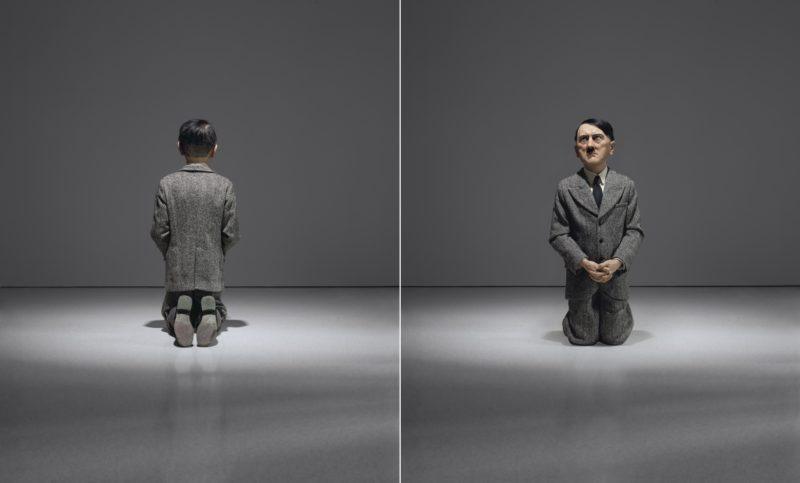
Maurizio Cattelan, Him, 2001
© Maurizio Cattelan
Courtesy Christie’s, New York
Another notable work, Now (2004), depicts a sharply dressed John F. Kennedy in an open coffin, eternally frozen in death. The piece shocks with its raw portrayal of political mortality, serving as both a meditation on the loss of a political icon and a broader reflection on the disillusionment that has permeated American society. Cattelan’s work forces the viewer to confront the grief tied to the death of a leader who once embodied hope and idealism. It reflects on the fragility of political ideals and the erosion of innocence, resonating deeply with themes of mortality. At the same time, it speaks to the growing cynicism and skepticism toward political figures in the years following Kennedy’s assassination.
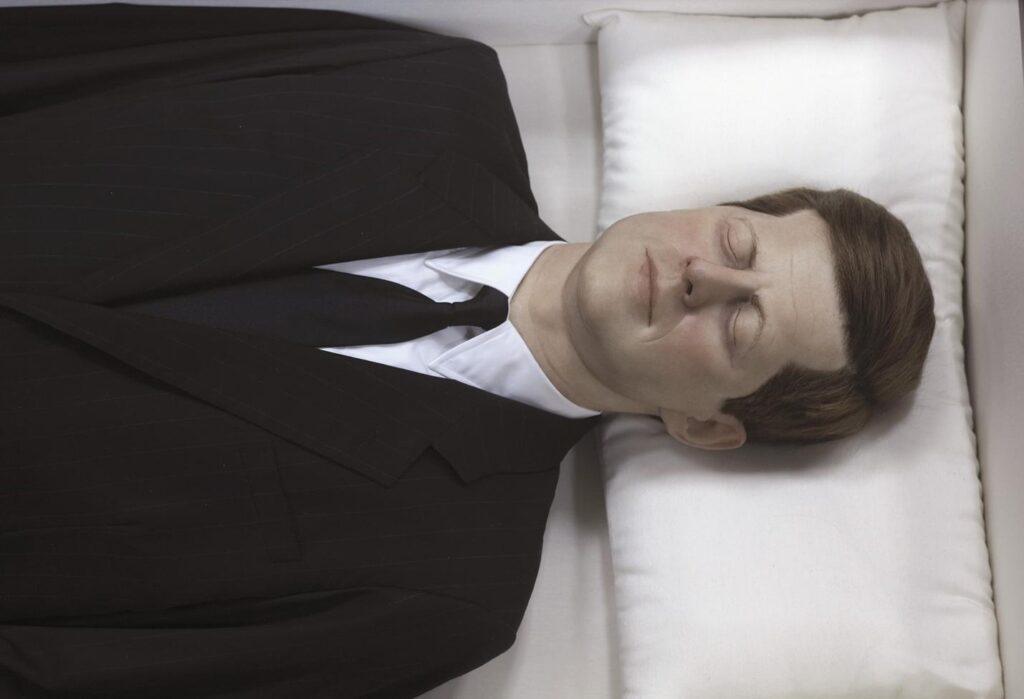
Maurizio Cattelan, Now, 2004
© Maurizio Cattelan
Courtesy Southbank Centre, London
Photo: Andrè Morin
Each of these works is a stark commentary on power, faith, and history, employing shock to make a lasting impact while prompting deeper reflection on the complexities of human experience.
Arguably one of the most shocking and talked about works, Cattelan’s Comedian (2019) stirred the art world when it was first sold as part of an edition of three at Art Basel Miami. Two of the versions sold for $120,000 each, while the third went for $150,000. The work consisted of a fresh banana affixed to a wall with duct tape. Buyers received a banana, a roll of duct tape, a certificate of authenticity, and instructions on how to install the work. But why buy a banana that was destined to rot? Well, essentially, those buyers bought the idea rather than the fruit. The very act of affixing the banana to a wall using duct tape adds layers of interpretation. It invites reflection on the tension between permanence and transience in art and life. While the banana is destined to decay, its preservation through tape and display conveys an effort to eternalize something inherently ephemeral.

Maurizio Cattelan, Comedian, 2019
© Maurizio Cattelan
Courtesy Sotheby’s, New York
Following its initial sale, the banana was replaced with a fresh one, perpetuating the cycle of consumption. In essence, the work critiques the contradictions and extravagances of the art market, challenging traditional definitions of art while spotlighting its inflated prices. Cattelan himself declared in a 2021 interview that he thought of the work as “a sincere commentary and a reflection on what we value.”
The saga of the wall-taped banana continued when Sotheby’s auctioned Comedian at its prestigious evening sale on November 21, 2024. The catalogue essay opened like this: “No other artwork from the twenty-first century has provoked scandal, sparked imagination, and upended the very definition of contemporary art like Maurizio Cattelan’s Comedian, whose debut at Art Basel Miami Beach in December 2019 captivated the world. Comprised of a banana fastened to a wall with duct tape, hung exactly 160 centimeters from the floor, Comedian belongs to the rare league of artworks that need no introduction, having quickly erupted into a viral global sensation that drew record crowds, social media inundation, landed the cover of The New York Post, and divided viewers and critics alike. Passionately debated, rhapsodically venerated, and hotly contested – and eaten not only once, but twice – the work headlined news stories shared around the world, becoming the most talked-about artwork of the century.”
Following a heated bidding session, Justin Sun, a Chinese collector, and founder of a cryptocurrency platform, acquired the work for $5.2 million hammer price ($6.2 million including buyer’s premium). The surge in the value of Comedian parallels the rise of another intangible asset: cryptocurrency. Much like conceptual art, where the focus shifts from physical objects to the ideas they represent, cryptocurrencies derive their value from decentralized networks and cryptographic protocols rather than tangible assets. This invites speculation: Was this shared emphasis on the intangible what drew Justin Sun to the work?
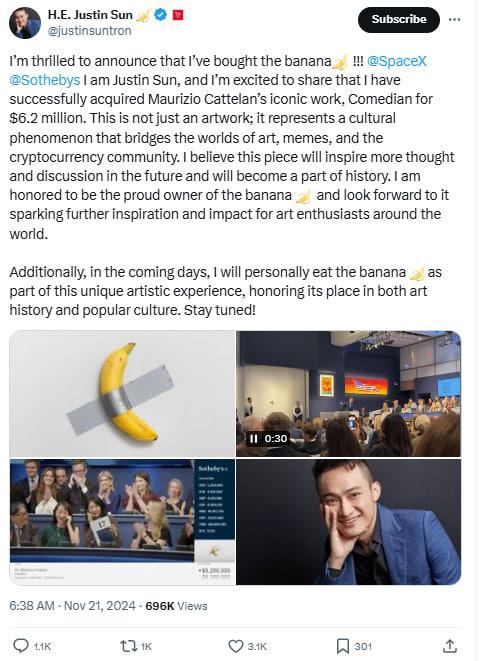
© Justin Sun
Courtesy Twitter
Cattelan’s taped banana, with its blend of absurdity, commentary on art consumption, and critique of the market, exemplifies the blurring of boundaries between art, performance, and commercialization. By challenging traditional definitions of art and inviting viewers to reconsider its value, Cattelan forces us to question not only the nature of the art world but also the ways in which we assign worth to ideas, objects, and experiences. In doing so, the work stands as both a symbol of the excesses of the contemporary art market and a reflection of the transient nature of value itself.
Maurizio Cattelan has consistently pushed the boundaries of art, challenging conventions, and reshaping our understanding of thought-provoking works. His ability to entertain, provoke, and inspire reflection has cemented his reputation as one of art’s most audacious figures. With each new creation, he continues to defy expectations, leaving us not only intrigued but eager to see what bold idea he will unveil next. It’s no surprise, then, that the question on everyone’s mind is: What could possibly follow Comedian?




Responses