
From Canvas to Catwalk: The Influence of Art on Fashion

Art and fashion have long been intertwined, with designers relying on art to turn utilitarian items into objects of desire. In fact, art has freed fashion – traditionally perceived as a custom or behavior – from the burden of conformity. The result: a thriving luxury goods market where garments and accessories are appreciated for their art-infused significance in addition to their aesthetic appeal. Indeed, art and fashion collaborations have increasingly blurred the lines between the two industries, expanding the reach of art to a wider audience while, at the same time, attracting collectors and investors seeking unique wearable items.
Below are some of the most memorable conversations between art and fashion:
The 1930s
Salvador Dalí x Elsa Schiaparelli
Born in Rome in 1890 to an aristocrat mother and scholar father, Elsa Schiaparelli founded Maison Schiaparelli in 1927. A rebellious fashion designer, Elsa Schiaparelli was known for her bold style which stemmed from her collaborations with artists such as Salvador Dalí, Jean Cocteau, and Alberto Giacometti. After seeing Dalí’s Lobster Telephone (1936), Schiaparelli collaborated with him on the creation of the Lobster Dress (1937). The floor-length silk dress features a lobster painted on the crotch by Dalí. For the Spanish Surrealist the aphrodisiacal crustacean was the epitome of sexuality. In Lobster Telephone (1936), he placed the lobster’s tail, where its sexual parts are located, over the mouth part of the receiver.
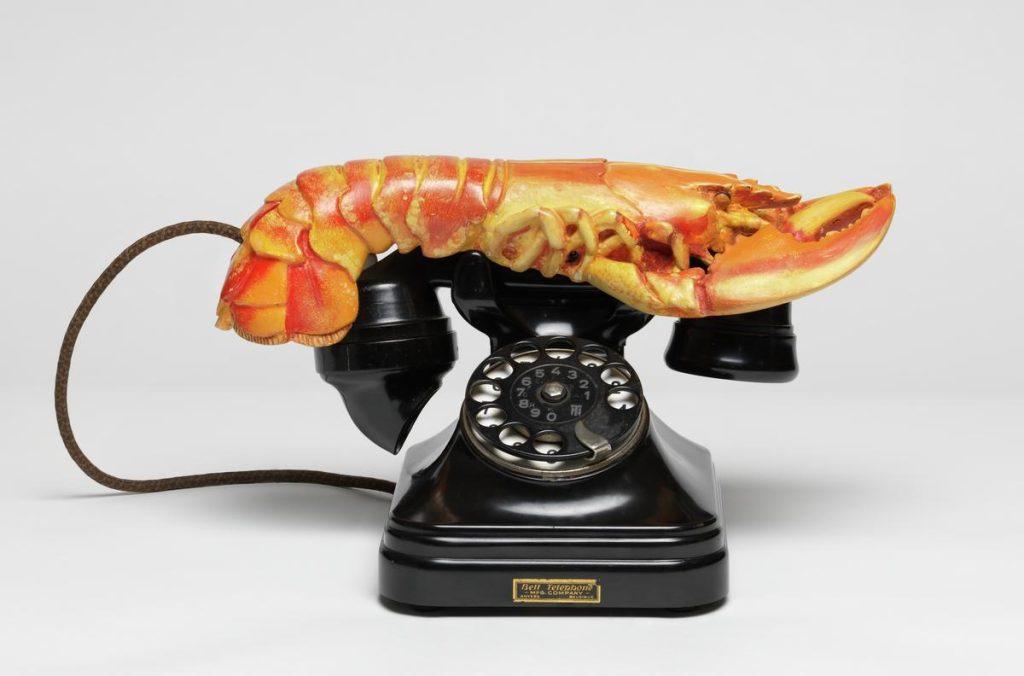
Salvador Dalí (Spanish, 1904-1989). Lobster Telephone, 1936. Steel, plaster, rubber, resin, and paper. Source: Tate, London
The iconic status of the Lobster Dress was sealed when Wallis Simpson wore the dress for Vogue, shortly before her June 3, 1937, marriage to Edward VIII.
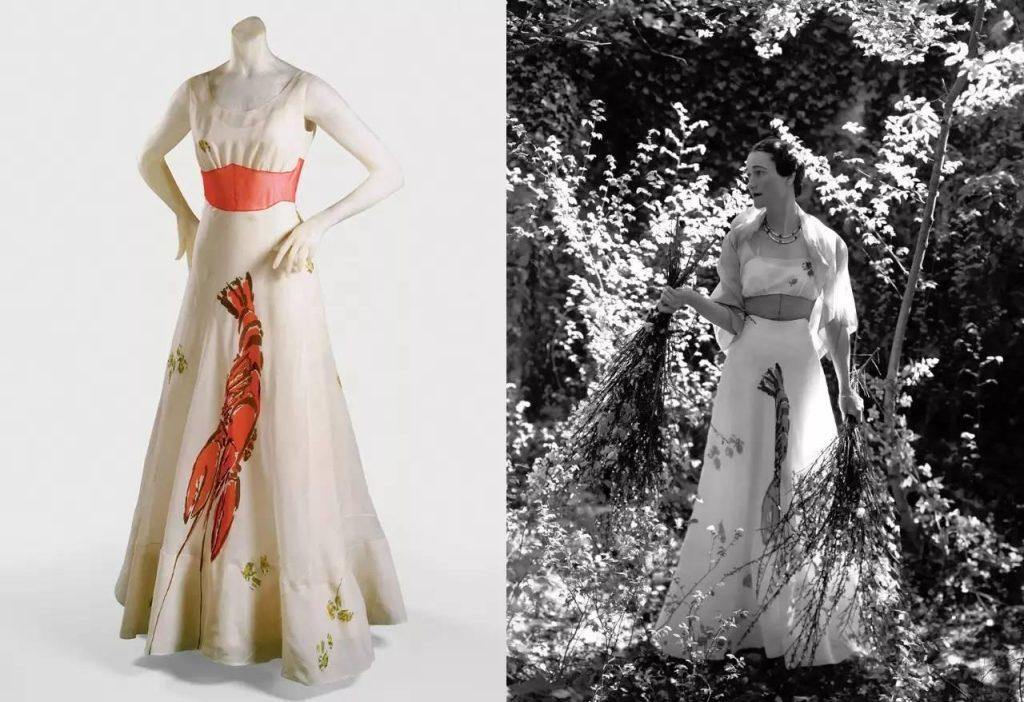
Left: Elsa Schiaparelli (Italian, 1890-1973) and Salvador Dalí (Spanish, 1904-1989). Lobster Dress, silk, 1937. Source: Philadelphia Museum of Art
Right: Cecil Beaton (British, 1904-1980). Wallis Simpson, 1937. Photograph. Getty Images. Source: Vogue
The 1960s
Piet Mondrian x Yves Saint Laurent
Coined by Dutch artist Piet Mondrian (1872-1944), Neoplasticism (the new plastic art) was a form of abstract art that combined vertical and horizontal lines with primary colors (red, blue, and yellow) to create a balanced relationship between contrasting forces. The artist’s Composition with Red, Blue, and Yellow (1930) is a prime example of Neoplasticism style and early 20th Century abstraction.
For the Fall/Winter 1965 collection, Yves Saint Laurent drew inspiration from Piet Mondrian’s Composition with Red, Blue, and Yellow (1930) and designed a series of six cocktail dresses that evoked Mondrian’s abstract lines, patterns, and colors. Collectively, these dresses became known as the Mondrian Collection.
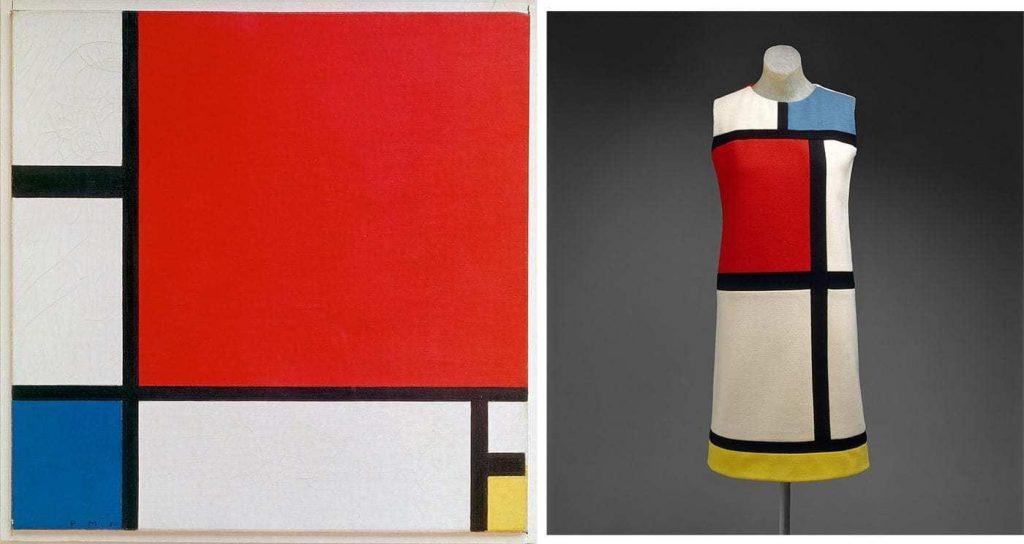
Left: Piet Mondrian (Dutch, 1872-1944). Composition with Red, Blue, and Yellow, oil on canvas, 1930. Source: Kunsthaus Museum, Zürich
Right: Yves Saint Laurent (French, 1936-2008). Mondrian Dress, Fall/Winter 1965 collection. Source: The Metropolitan Museum of Art, New York
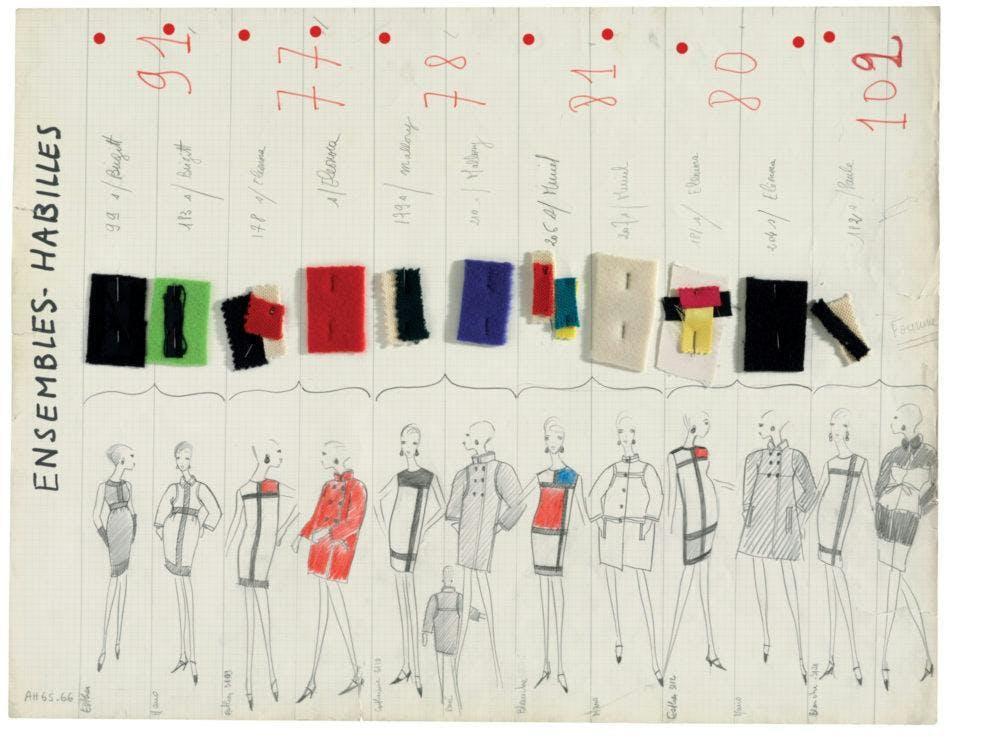
Yves Saint Laurent (French, 1936-2008). Notes from the YSL Fall/Winter 1965 collection. Source: Museé Yves Saint Laurent, Paris
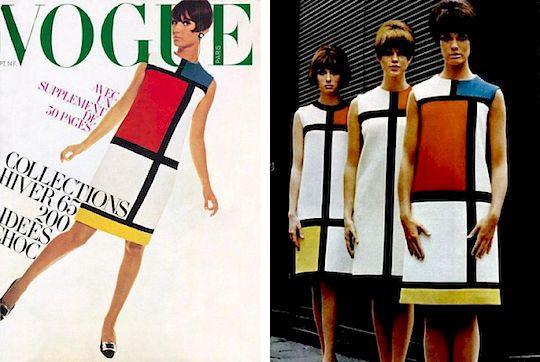
Mondrian Dress, French Vogue, September 1965
The 1990s
Andy Warhol x Gianni Versace
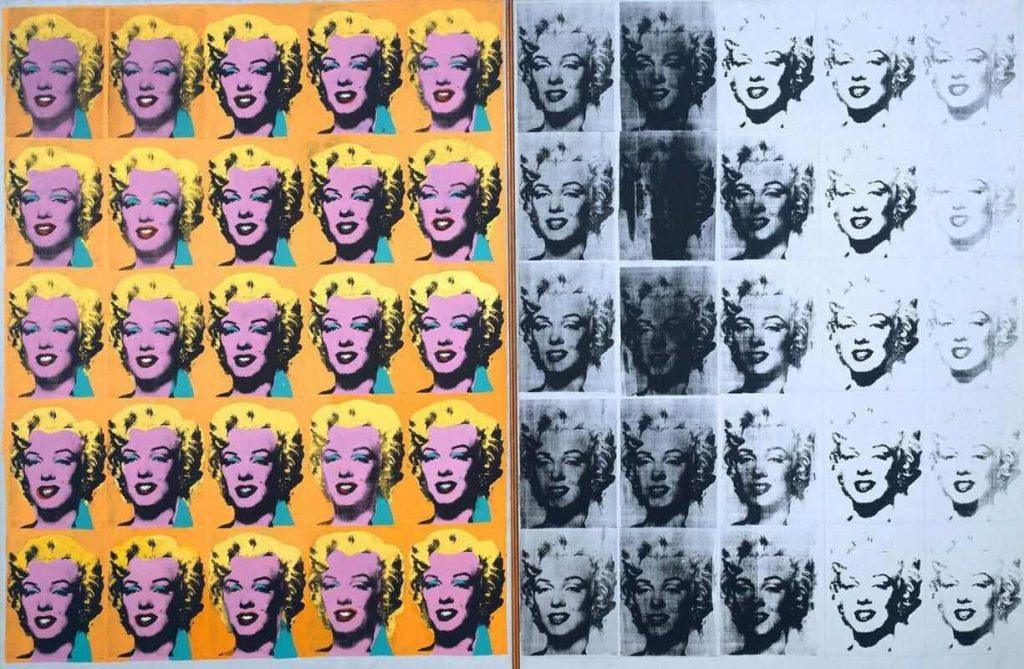
In the summer of 1962, Warhol was experimenting with silkscreening, a production method used in commercial printing. Following in Marcel Duchamp’s footsteps, he started using existing photographs as readymades to create new works of art. The idea that previously published images could be appropriated and reintroduced in the art circuit as consumables fascinated him. Additionally, his love affair with untimely death and celebrity drama played a key role in the marriage between glamour and popular culture and ultimately led to his success as a Pop artist. Pat Hackett, Warhol’s long-time friend, writing as Warhol, explains: “I wanted something stronger that gave more of an assembly-line effect. With silkscreening, you pick a photograph, blow it up, transfer it in glue onto silk, and then roll ink across it so the ink goes through the silk, but not the glue. That way you get the same image, slightly different each time. It was all so simple quick and chancy. I was thrilled with it. My first experiments with screens were heads of Troy Donahue and Warren Beatty, and then when Marilyn Monroe happened to die that month, I got the idea to make screens of her beautiful face-the first Marilyns.” (A. Warhol & P. Hackett, Popism, New York, 1980, p. 22).
Warhol used Gene Korman’s 1953 photograph made for the promotion of Niagara, the movie that launched Monroe’s career as a serious actress and established her stardom. Despite being immortalized by the silver screen as the ultimate sex symbol, Warhol focused on her facial features, rather than her body. The photograph depicts an intimidating, yet vulnerable twenty-six-year-old Marilyn. The epitome of seduction, Marilyn is shown with her fiery red lips slightly parted revealing a mischievous smile and gleaming white teeth. Her eyes envelop the viewer in a sensuous gaze while her bright yellow hair lends the image a saintly aura.
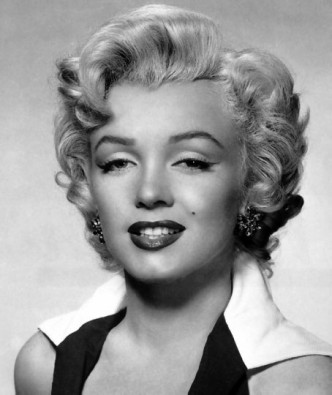
Original publicity still for the 1953 film Niagara. Source: Museum of Modern Art, New York
Andy Warhol (American, 1928-1987). Marilyn Diptych, oil on canvas, 1962. Source: Tate, London
Andy Warhol painted Marilyn in the month immediately following her death. He created twelve single Marilyns each with a different colored background. They became known collectively as the Flavor Marilyns. Of these paintings, Gold Marilyn Monroe is in the collection of the Museum of Modern Art New York, Blue Marilyn is the collection of Princeton University Art Museum, Green Marilyn is in the collection of the National Gallery of Art, Washington, DC, Licorice Marilyn is part of the Stephanie and Peter Brant Foundation in Greenwich, Connecticut, Mint Marilyn was a gift of Warhol to Jasper Johns, and Marilyn Diptych is at Tate Modern in London.
For Marilyn Diptych (1962) Warhol chose saturated green as the color of Marilyn’s eye shadow. To add vibrancy to the monochromatic background, he used the same shade of green to paint her collar. By enhancing every detail of her deeply revered features Warhol managed to transform Marilyn’s photograph into a timeless symbol of Pop art, a feat that resulted in his portrait of Marilyn becoming even more iconic than the publicity image it stemmed from.
Similarly, Warhol’s rendering of James Dean brings to the fore the image of the hopelessly charming playboy, taken too soon, and adored all the more for his untimely demise. Dean’s portrait, created only two years before Warhol’s own death, ties in many central themes to the artist’s career, among them notions of celebrity, tragedy, and iconic status.
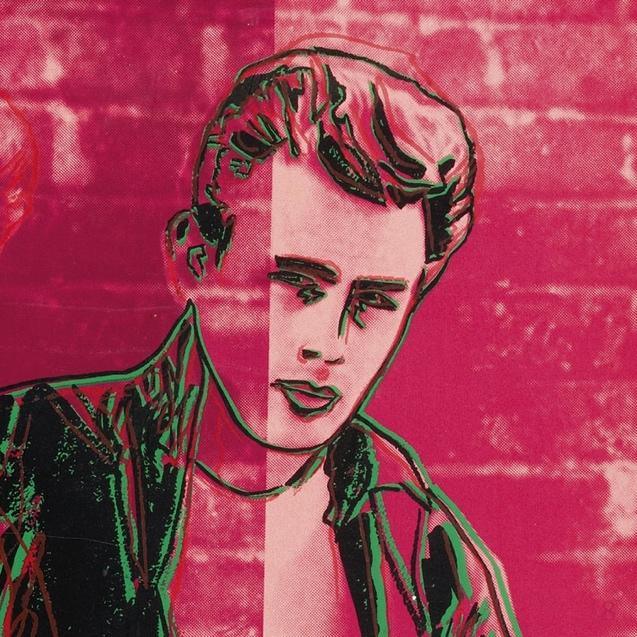
Andy Warhol (American, 1928-1987). Rebel Without a Cause (James Dean), silkscreen, 1985 (detail). Source: Sotheby’s
For the Spring/Summer 1991 collection, Gianni Versace merged his love for art with fashion. He appropriated Warhol’s paintings by transforming the artist’s two-dimensional renderings of iconic portraits into three-dimensional garments. Several pieces featured brightly colored, silk-screened portraits of Marilyn and James Dean. Versace named his collection the POP collection.
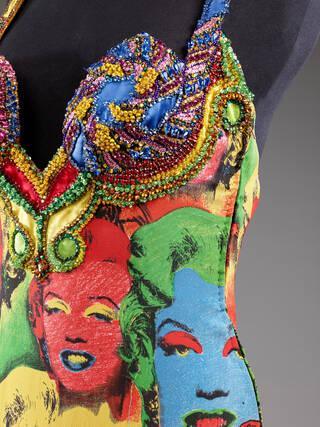
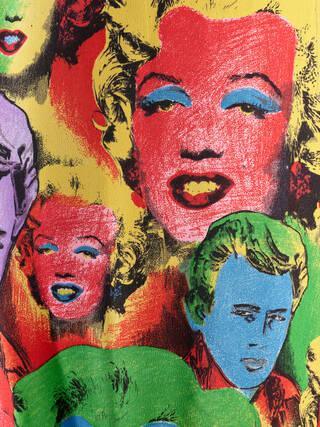
Detail of dress, Versace Spring/Summer 1991 Collection. Photo: Victoria and Albert Museum, London
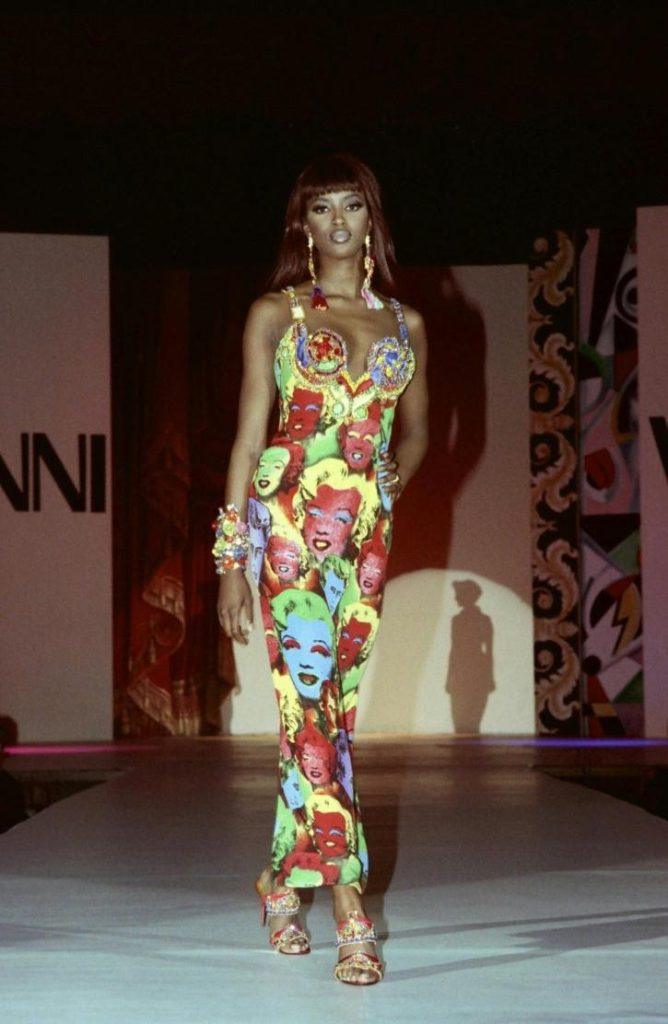
Naomi Campbell (British, b. 1970) struts down the runway dressed in a gown by Gianni Versace (Italian, 1946-1997), Spring/Summer Collection 1991.
Each of these examples highlights how art can profoundly influence fashion, resulting in wearable masterpieces that pay tribute to the creativity and vision of renowned artists and art movements.


Very cool article!! 😍